With a full 21(!) years on the clock since the first Vampire The Masquerade: Bloodlines released exclusively for PC platforms in 2004, Vampire: The Masquerade – Bloodlines 2 feels like something of an elder vampire itself – one that has reawakened after a lengthy torpor into a world that has moved on since it last made its presence known in the games industry. Of course, there have been no shortage of games set in World of Darkness’ arguably most popular setting, with the likes of Vampire: The Masquerade – Swansong and the Vampire: The Masquerade Coteries titles being the most prolific examples of this.
However, the very fact that Bloodlines 2 is a sequel to a title that is so fondly remembered by a generation of gamers that, dare I say, have aged somewhat since the release of the first Bloodlines effort, places something of an expectation on this title that is difficult to shake. Complicating things yet further is the fact that Bloodlines 2 has had something of a troubled development history to say the least – with coding duties shifting from Hardsuit Labs to The Chinese Room in 2021 (they of Dear Esther, Everybody’s Gone To The Rapture and most recently, Still Wakes The Deep fame), it’s fair to say that this is a title that has somewhat tripped and stumbled on its way to the release finish line – and that’s to say nothing of the recent paid DLC controversy that the studio found itself embroiled in.
Vampire: The Masquerade – Bloodlines 2 PS5 Review
A Moody Combat/Stealth RPG Hybrid That Does Justice To The Source Material But Which Also Deserves A Better Open World
Taking all of that into account then and the fact that Vampire: The Masquerade: Bloodlines 2 is very much a real thing that you’ll be able to hold in your hands very shortly, I feel like it’s important to concentrate on what Bloodlines 2 actually is, rather than projecting upon it what we might necessarily like it to be. To be clear then, Bloodlines 2 perhaps isn’t the sort of massively sprawling, open world RPG that many folks had been hankering for, but instead something which maintains that open world design as a framework upon which its decidedly more focused combat and stealthy beats are attached.
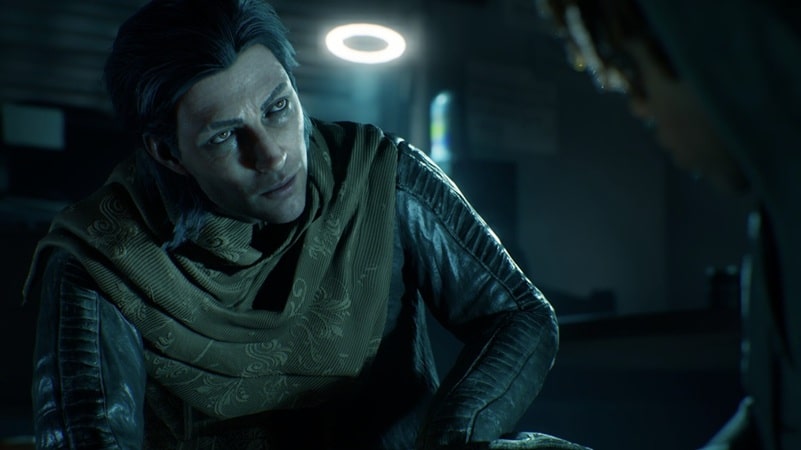
Before we get into the weeds of the mechanics, it’s important to frame the setting of Bloodlines 2 which invariably stands out as one of its most potent qualities. Cast as the enigmatic Nomad, an elder vampire of some renown, you are awakened after a century-long slumber, finding yourself surrounded by a modern world steeped in unfamiliarity. Complicating things further are the fact that in addition to being awoken in a world that has moved on, is the fact that the Nomad is also seemingly sharing a body with Fabien, an eccentric vampire detective from the Malkavian clan who is also searching for his own answers in a mysterious world that appears reticent to give up its secrets.
After an initial bout of amnesia, our Nomad begins to remember the clan that they belong to and it’s here where Bloodlines 2 permits the player to pick from the Brujah, Tremere, Banu Haqim, Ventrue, Lasombra and Toreador clans available. Each of these clans has its own affinities which reduce the cost of certain abilities but also boast different levels of mastery difficulty too.
It’s perhaps important to remember at this point that Bloodlines 2 is decidedly not a full-fat RPG in the vein of something like Baldur’s Gate 3 or even something like Mass Effect, and so this means that the opportunities to properly role-play these clans as you might expect to in other Vampire: The Masquerade works is quite limited. As such, the main points of differentiation are in those previously mentioned abilities and skills which dovetail into Bloodlines 2 overall stealth and combat gameplay loops, which I’ll get into the weeds on shortly.
As anyone who has previously sunk their figurative teeth into the Vampire: The Masquerade setting can appreciate then, Bloodlines 2 very much focuses on the broad social tumult and layered politics that comes with having multiple vampire clans waging a shadow war for supremacy. This struggle predictably manifests itself directly within the game itself too, as you find yourself going from clan to clan, taking on main missions and side missions that can affect your standing with each clan respectively.
To enable the different and often conflictingly intersectional relationships that you’ll hold with each of the clans, Bloodlines 2 also opens up a non-linear dialogue system where you can not only ingratiate (or not) yourself to various folks, but also make key decisions which cause the narrative to go down one avenue or another, providing Bloodlines 2 with some solid replay value as a direct result.
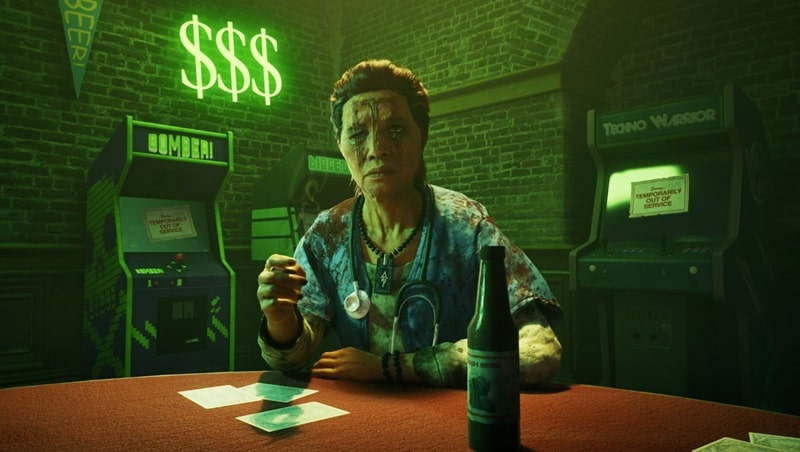
The writing is also pleasingly accomplished for the most part, with the Nomad (or the somewhat cringey ‘Phyre’, as they are known) able to respond with a kaleidoscope of different responses that would fit in perfectly with a tabletop session of Vampire: The Masquerade. Indeed, the various vampire folk that fill the world of Bloodlines 2 are also similarly well fleshed out too, with Tolly the charismatic Nosferatu offering up a particularly over the top presence, while Fabien helps bring our protagonist up to date with all of the technology and social trends that have emerged during their slumber.
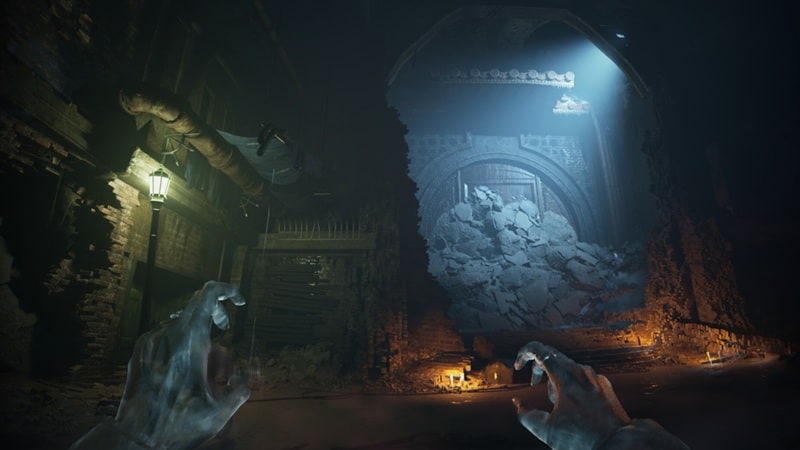
Another aspect of Bloodlines 2 which very much evokes the essence of the setting with which it shares its namesake, is the game world itself, at least aesthetically speaking. Indeed, Bloodlines 2 depiction of a modern day Seattle ruled by a shadowy vampire court is both moody and cut-it-with-a-knife atmospheric and this standard of visual presentation very much plays to The Chinese Room’s significant and established strengths in this regard.
Further Reading – Upcoming PS5 Games 2025 – The Best PS5 Games Coming Soon
Simply put, I love the density and lived in feel of Bloodline 2‘s many interior urban environments. Phyre’s haven (their home) is filled with many such handcrafted touches as moonlight creeps through partially opened curtains in a messy apartment filled with all the incidental chaos of an untidy mind as a defiled flat filled with mold stretches out before the player, alongside candles set atop piles of books, occasionally flickering lights, a seemingly well-used ouija board and even a long dead cat all serve to evoke a particularly grotesque domesticity – yet one that unmistakably bears the signs of a (un)life that has been lived there.
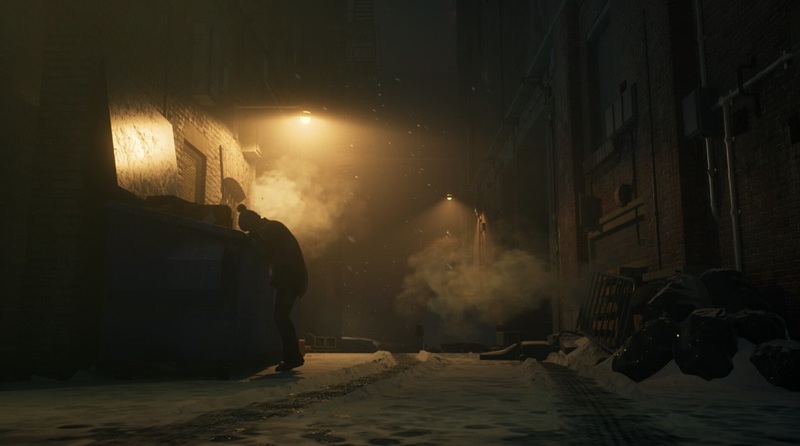
Though when you walk out into the snow-caked and decidedly festive streets of Seattle for the first time (yes, Vampire: The Masquerade: Bloodlines 2 is essentially a ‘Christmas game’, I suppose you could say), as neon signs and billboards light up your periphery, the outside world of Bloodlines 2 also feels appropriately atmospheric here too, as the human folk huddle around fires and grimly go about their own business in a city seemingly locked in a foreboding permafrost. Arguably though, it’s really in the detail-dense interior areas which are absolutely dripping with atmosphere that Bloodlines 2, and by extension The Chinese Room itself, does its best work.
Speaking of the outside open world of Seattle, it’s here that Phyre can traverse from one key location to the next and this traversal feels at once super satisfying, as you leap from one building to the next, speed across rooftops and glide through the streets. The main flaw of Bloodline 2‘s open world however, is that there simply isn’t enough to do within its snow-dappled boundaries. Certainly, Bloodline 2‘s take on modern day Seattle is fairly bereft of interesting things to do and see beyond the side and main quests, with no real incidental things or unexpected events that can happen to our fanged protagonist. It’s also worth mentioning that there is no fast travel either, which can make the to and froing between previously visited locations a tad more laborious than it necessarily needs to be.
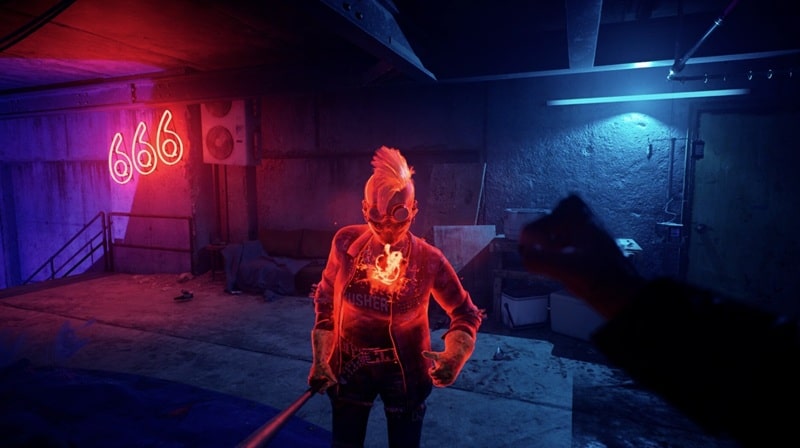
What fares a fair bit better however, are the combat and stealth pillars which form the respective foundations of Bloodlines 2 primary gameplay loops. Essentially, when you’re not hunting around the environment for XP-giving clues, you’ll be stalking about the place and/or punching undead things really, really hard in the face until they stop moving.
Starting with the stealth side of things, Bloodlines 2 does an admirable job of making you feel not just like a vampire, but a properly powerful one that is only now just awakening to the extent of their powers. In practice, this means that you can not only creep around in silence and quickly dash across and up surfaces, but you can also execute foes with a grisly takedown (from either behind or from a height), cover a tremendous amount of distance in a blink of an eye and get in and out of combat extremely quickly indeed. As such, The Chinese Room roundly succeeds in empowering the player and making them feel like an endlessly agile terror, which is exactly how you would imagine a vampire to be.
Combat meanwhile, is rapid, visceral and surprisingly satisfying. Often surrounded by multiple enemies at once, Bloodlines 2 is all about landing a succession of melee strikes on your opponent, breaking through their block and executing them/draining their blood to replenish your own health when they become weak enough to do so. Involving much more than just attacking your foes, success in Bloodline 2‘s many fistic confrontations is also largely dictated by how well you can evade at speed from incoming attacks as well – always ensuring that you have a good grasp on your surrounding environment into the bargain.
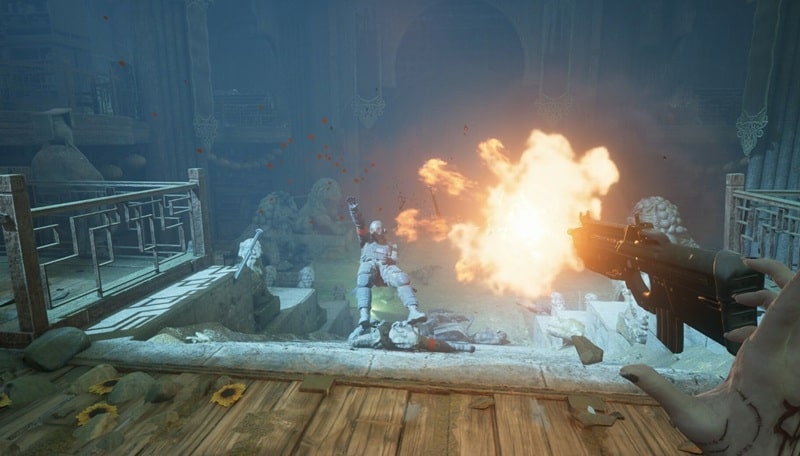
Of course being an elder vampire means that you have access to more than just a boxer’s arsenal of strikes and this manifests itself in the various abilities and skills that you can unlock throughout the game. Not only can you use telekinesis to pull enemies and snatch their weapons from them (including firearms), but there are a wealth of specialised powers that you can earn which can quickly turn the tide of battle as well. From a lightning fast storm of strikes that can target multiple enemies within a split second, to a running chokeslam into the nearest wall, a blood curse that can make enemies explode and even a thunderous attack that can cause a localised earthquake which throws your hapless adversaries into the air, these abilities make Bloodline 2‘s already enjoyable combat that much more so.
This wouldn’t be much of a review if I didn’t spend some time talking about how the titular masquerade figures into Bloodline 2‘s overarching game design. As a vampire you are bound by the masquerade – a pact that exists between all vampire clans which penalises any use of their supernatural powers in front of humans, since doing so would eventually cause a human uprising that with their greatly superior numbers would soon result in the complete extermination of the vampire race. As such, infractions on the masquerade such as drinking blood in public, using your fast dashing or long leaping powers, or any act of violence, will result in the masquerade eventually crumbling – with a final masquerade breach resulting in a hidden vampiric hunter tracking you down and jamming a stake into your chest.
Because of this, you need to be careful about how you carry yourself in the game world. Want to drain someone’s blood? Well, you’ll need to tempt them into a nearby alley away from prying eyes to get the deed done. Want to get one from location to another quickly without being seen? The best way to do that is to ascend to the rooftops of Seattle before sprinting, leaping and gliding your way to destination – again, out of the view of human peepers. Speaking of blood drinking, this might seem obvious, but as a vampire this is something you’ll want to do fairly frequently for a number of reasons. The first and most obvious of these reasons is that as you accumulate damage, you’ll need to glug down some of that sweet claret in order to heal yourself. However, perhaps the most important use for blood drinking in Bloodlines 2 is how it dovetails into the progression systems that are in place.
You see, while you can invest XP earned from killing enemies, discovering clues in the world and completing quests to fill out your progression tree, you can also branch out into ability trees that would normally be reserved for other vampire clans by drinking specific types of blood to get there – and such blood can be found in the necks of the various unfortunates that stalk the streets of Seattle. It’s a neat system all told that provides ample scope for progression, but because you have to go through the motions time and again of dragging someone to a dark place, drinking their blood and then scooting off to do it again – it does mean that the whole thing can feel a little repetitive after a while.
Perhaps the final word that needs to be said regarding the game design of Bloodlines 2 is in how it surprisingly flip flops between players controlling Phyre and players taking the reins on Fabien, whose memories surface as playable detective sequences when Phyre slumbers. During these sequences, Bloodlines 2 arguably feels much more like a traditional title from The Chinese Room, as our fanged sleuth uses his Malkavian abilities to trick and hoodwink his way through various investigations in which the usual combat shenanigans of the game are notably absent in favour of these slower paced detective beats.
From a technical perspective, Bloodlines 2 is a mixture of the good and the bad. The good of course is that The Chinese Room knows how to create gorgeously lit internal environments and high fidelity character models that all look like they’ve been pulled right from the pages of the Vampire: The Masquerade tabletop game itself. The bad however, is that the game is in need of a fair dollop of extra polish.
Pointedly, on PS5 and PS5 Pro you have access to the usual set of 30 FPS quality and 60 FPS performance modes. The problem though, is that the quality mode is so choppy and doesn’t have any decent motion blur to speak of and so isn’t really a viable alternative to the 60 FPS performance mode. The problem with the performance mode though, is that even on PS5 Pro the 60 FPS limit is rarely kept and VRR busting drops are frequent throughout the game – especially during encounters with multiple enemies in Bloodline 2‘s frosty open world. Throw in some sizable, nearly a second long stutters, the occasional crash which whisks your back to the PS5’s front end and a seeming total lack of PS5 Pro enhancements and it’s clear that Bloodlines 2 would have benefitted from some more development time.
Vampire: The Masquerade: Bloodlines 2 might not be the sequel that folk from 2004 wanted for their game, but it is the game we’ve got. Though largely sparse open world and technical issues are hardly encouraging, the beautifully evocative interior environments, surprisingly engaging traversal and combat mechanics, together with its neatly unconventional ‘buddy movie’ conceit which sees two vampires attempting to inhabit the same body and each with their own motivations, makes Vampire: The Masquerade: Bloodlines 2 a good deal more intriguing than I originally expected it to be.
Vampire: The Masquerade – Bloodlines 2 released for PS5 on October 21, 2025.
Review code kindly provided by PR.