Romeo Is a Dead Man PS5 Review. From reveal to release, Romeo Is a Deadman carried the signature Suda51 charm that we all love his games for. And having beaten the game for this review, that spirit is one that exists in every fibre of this game’s being. It is unapologetic, unrestrained and downright weird in ways that I wasn’t expecting, in the best possible sense.
It doesn’t dwell on details, it just throws you headlong into a game that feels like an enraged scream against formula, structure and everything that modern standards cling to. It isn’t without fault, but this is a game that never shies away from what it wants to do, when it wants to do it.
Romeo Is a Dead Man Review (PS5) – Romeo Is A Great Man
A Tale As Old As Time
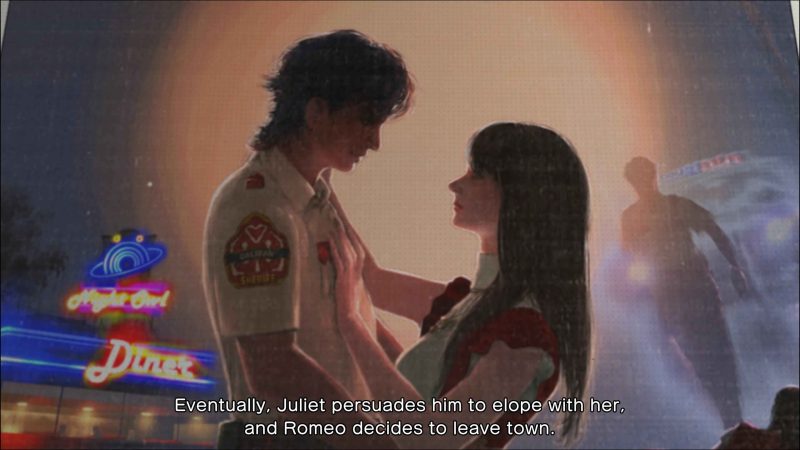
Romeo Is a Deadman wastes absolutely zero time with preamble or exposition; you play as Romeo, who after a horrific accident becomes “DeadMan,” a half-human and half-life support hybrid who is sent on a mission across space and time to discover the truth behind the fractured town of Deadford, and exactly what could be causing it.
Beneath this premise is a romance that befits the name “Romeo,” as he sets out to discover the truth of the woman he found in the road, Juliet. Across a handful of different eras, Romeo comes across a variety of off-beat characters that all manage to be totally singular and bizarre in their own right. From an undead crime boss, to the lead doctor of a run down asylum, each villain you come across revels in their villainy, and each is memorable in their own regard.
In any other game, I might say that the pacing is that bit too fast, but that feels by design here. We aren’t ever made privy to the exact circumstances behind every character relationship, but that’s because we’re here for the ride, not the setup. It revels in absurdity and demands that you roll with the punches to keep up with it.
I speak in vague strokes for one reason; to explain the plot of Romeo is a Deadman is to go down a laundry list of “then this happened, and then this happened”. In his signature style, Suda51 doesn’t adhere to any kind of formal structure in his storytelling. The most formulaic part of the game comes in the visits to different eras and adventuring through each. What happens within each of those areas is something that I’ll refrain from sharing here.
Not even out of some embargo obligation, I simply think that the experience is best left completely unspoiled before you venture in. Watch the trailers, be befuddled, and let it just roll as it does.
Dealing with the Dead
The vast majority of your time with Romeo is a Dead Man will be spent with the action-combat segments, exploring various ages and places throughout the town of Deadford. Your first battle might be in the forest outside of the town, but you very quickly start exploring areas that you might not have first expected.
We’ve all played action games set in abandoned malls, but how many have you played where you explore the mayor’s offices? There are other brilliant set pieces that are each fleshed out and given plenty of space to breathe, with all of them managing to stave off any repetition through engaging changes of pace.
Combat itself is of a similar calibre to the fare that we’ve had in games like No More Heroes, which is to say, great stuff. Romeo has access to four main melee weapons and four ranged weapons that each have distinct pros and cons, and I was encouraged to switch through them on a dime. At the same time, I was never fully required to jump from one to the other if I didn’t feel like it.
You can very quickly unlock the lot of them and upgrade them as you wish, with each bringing a new dimension to combat. You can choose to stick with the all-rounded default sword, or lean in closer with knuckles, or even keep the distance with a weighty greatsword. None of them felt weaker than the others, and it felt very much down to you.
You’ll find your favourites, and you can stick with them if you like. A playthrough on the normal difficulty had me feeling healthily challenged without erring into frustration, once I’d played my cards right.
Combat feels weighty and punchy, without feeling too heavy. Romeo Is a Dead Man is taglined with “ultra-violent science fiction” and that label feels appropriate. The amount of blood that comes out of just regular enemies borders on comical, and is some of the best visual feedback I’ve seen for basic combat in recent memory. This ties neatly into “Bloody Summer,” a special attack with a psychedelic punch that heals your enemies after gathering enough blood.
Everything feeds brilliantly back into itself, and very rarely loses any steam thanks to just how tight the combat feels, and the abundant viscera the game treats you to. It’s a sight to behold.
Dancing Around Combat
There is more to Romeo Is a Dead Man than just the combat, there’s a surprising focus on exploration that I found interesting, if not fully realised. Between combat encounters, you’ll often jump in and out of televisions taking you to “subspace.” These areas are combat-free zones that are home to environmental navigation challenges, as well as light puzzle solving as to where you need to go next. These puzzles aren’t exactly the most engaging (spinning wheels and cracking vaults, anyone?), but they still exist to break up the combat.
Bookending these areas are strange soliloquies from a faceless man who genuinely does sound like he could have been ripped from a Shakespearean play of his own. I shan’t spoil any of their contents here, but I enjoyed each and every one for how utterly bizarre they get. It adds to the experience, and some managed to get me to actually laugh, which is a rarity for dialogue in a game like this.
The only issue I had with these areas is how the game sometimes feels like they maybe weren’t built with it in mind. Romeo controls rather stiffly in the air, and this led to a handful of occasions where I would slip, fall and ultimately have to retrace my steps through an area that already looks similar to places that I’ve been exploring for tens of minutes.
Despite enjoying the ethereal use of jazz, I found subspace to be a repetitious place to come in and out of, especially when the rest of the game is so visually varied.
I did also have the misfortune of encountering a bizarre bug where I ended up falling through the floor and having to reload an earlier save to get out of a softlock. It only happened the once, but was a bug that cost me nearly 40 minutes in progress. Not ideal.
A Unique Set of Skills
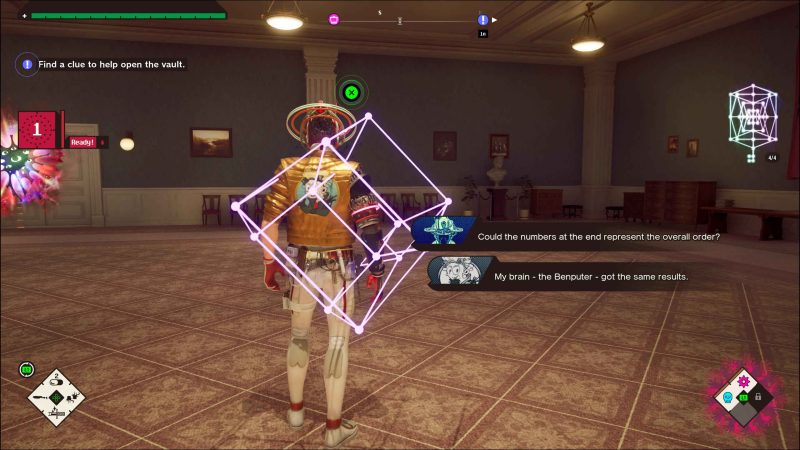
Where the general flow of the game as described above forms the skeleton of Romeo is a Dead Man, the meat on that skeleton is utterly bizarre and truly singular. First is the Bastard system. Over the course of the game, you’ll gather Bastard seeds that you can grow into creatures with particular abilities to execute on a cooldown. These abilities range from area of effect healing, poison shots, or just a straight up bomb that you can send into groups of enemies.
Appropriately, these creatures that you bring with you are called Bastards. No reason. That’s just what they are. You can fuse them into stronger Bastards by sending two weaker Bastards to fight each other and see who wins. It’s a great system that made me laugh every single time I had to use it.
You’ll also gather ingredients for curry across various areas, and turn them into usable katsu curries on your ship with a cute timing mini-game.
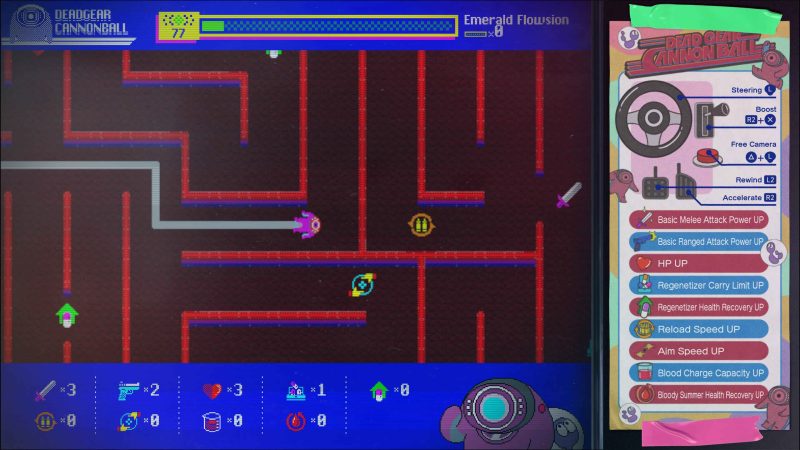
Where progression really shines is in the freedom that you have to upgrade whatever attributes you consider the most important. Through a light mini-game, you spend currency to send a creature through a maze and gather up power-ups for Romeo. You have total control over what you choose to upgrade, having to make efficient use of what you’ve got to get the bang for your buck. When coming up against a particularly nasty boss in the early game, it was nice to know that I could refund all my money and respec as I wanted to, with no consequence.
Instead of investing purely in attack buffs, I put a few more stocks in my regenerating healing item. Over time, you’ll basically have enough to unlock everything you need, but it’s a fun layer of meta progression that once again adds a unique flavour to a system that most games simply take for granted.
Surfing the Groovy Waves of Love
Taking it as a whole, Romeo Is a Dead Man is unlike any game that I’ve played. It’s bizarre, it left me guessing, it threw punch after punch and almost all of them landed in service of the greater piece of art that Suda has presented us here.
Every small artistic wrinkle serves a game that has a singular vision. Every corner brought something new, and it’s a game that I cannot wait to return to in the years to come. A foundationally strong base supports a game that isn’t scared to just be.
Goichi Suda has often spoken about his desire to deliver games that deviate from the norm, and that is absolutely the case here. Nothing about Romeo Is a Dead Man comes close to being conventional, and that is why it shines so brightly.
Suspend your disbelief, and let the game take you on that ride. You will not regret it.